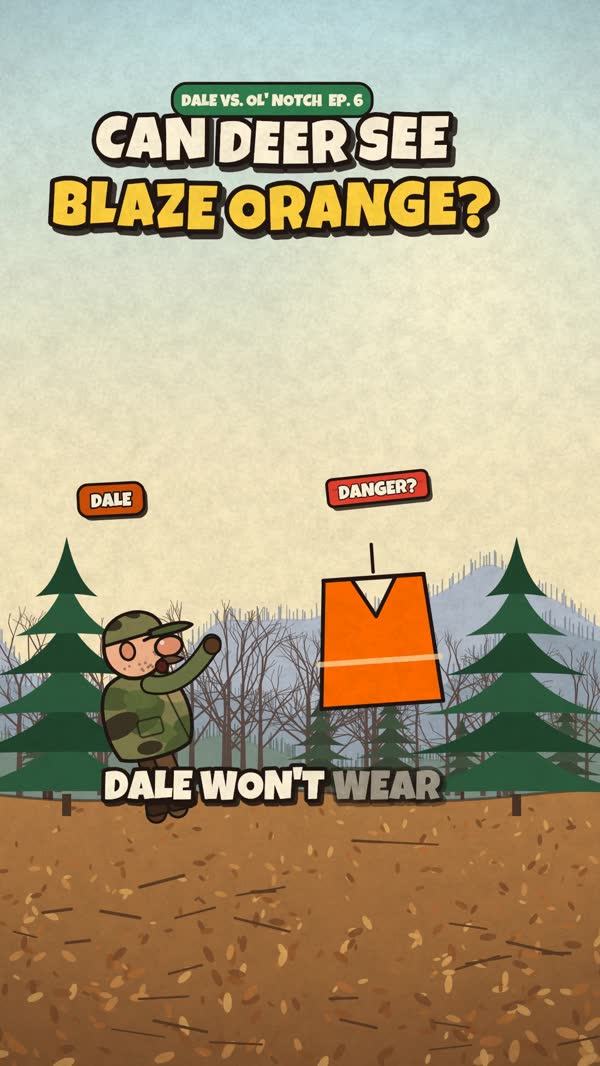
01What the research found
RECEIPT
The study
Georgia: what colors deer pick up
WhereCaptive deer, University of GeorgiaSample7 captive adult does
What they did
Trained deer in forced-choice tests with lights at different wavelengths, including 590 nm and 650 nm, the orange and red end.
What they found
- Deer are dichromats. In the thesis's words, "their eyes contain two types of cones."
- Deer have "a greater perceptual sensitivity to shorter wavelengths and lower sensitivity to longer wavelengths."
- For comparison, people have three types of cones.
Limits
- A small study: 7 semi-tame, penned does, ages 2.5 to 5.5.
- Blaze-orange fabric was not tested.
- "Less sensitive" means it takes more light for them to detect it. It doesn't mean they can't see it.
- The human cone count comes from a health page, not the deer papers.
Source. Cohen, Osborn, Gallagher, Warren and Miller. 2014. "Behavioral measure of the light-adapted visual sensitivity of white-tailed deer." Wildlife Society Bulletin 38(3): 480-485. Also Cohen 2011, MS thesis, University of Georgia. Human cones: Cleveland Clinic, "Color Blindness." doaj.org → getd.libs.uga.edu → my.clevelandclinic.org →
RECEIPT
The study
Inside a deer's eye
WhereUniversity of Georgia studySampleEyes from 6 wild does (3 fawns, 3 adults)When2007
What they did
Looked at how the cone cells are laid out across the back of the eye.
What they found
- The cones are "concentrated in a horizontal visual streak."
- The author's words: "The visual streak provides deer with enhanced surveillance of a broad area."
Limits
- Eye anatomy, not a behavior test.
- 6 deer.
Source. D'Angelo, G.J. 2007. "Development and Evaluation of Devices Designed to Minimize Deer-Vehicle Collisions." PhD dissertation, University of Georgia, Chapter 3. getd.libs.uga.edu →
RECEIPT
The study
New York: hunters mistaken for game
WhereNew YorkSampleHunting-associated firearm injuriesWhen1989-1995
What they did
Looked at hunting-associated firearm injuries in New York and whether the injured hunter wore hunter orange.
What they found
- Of the 125 incidents where the injured hunter was mistaken for game, 117 (94%) weren't wearing hunter orange.
- Six (5%) were wearing hunter orange.
- Of 78 turkey-hunting injuries, 61 (78%) came from one hunter mistaking another for game.
Limits
- Older data.
- It covers all hunting, turkey hunters included, not just deer season.
- At the time, New York hunters weren't required to wear high-visibility clothing.
- Orange helps against being mistaken for game. It doesn't protect anyone who is in the line of fire.
- A safety report, not a deer study.
Source. CDC. 1996. "Hunting-Associated Injuries and Wearing 'Hunter' Orange Clothing, New York, 1989-1995." MMWR 45(41): 884. cdc.gov →
02My read
MY READMy tactic, not a study result
Deer may still pick up orange, but moving is what busts you. Wear it and sit still.
That's my read, not something these studies tested.
03Field notes
- Wear the orange. Less sensitive isn't the same as blind, and the New York numbers are why it matters.
- Sit still. Deer eyes are built for watching a broad area.
- Check your own state's season dates and legal hours with your state wildlife agency.