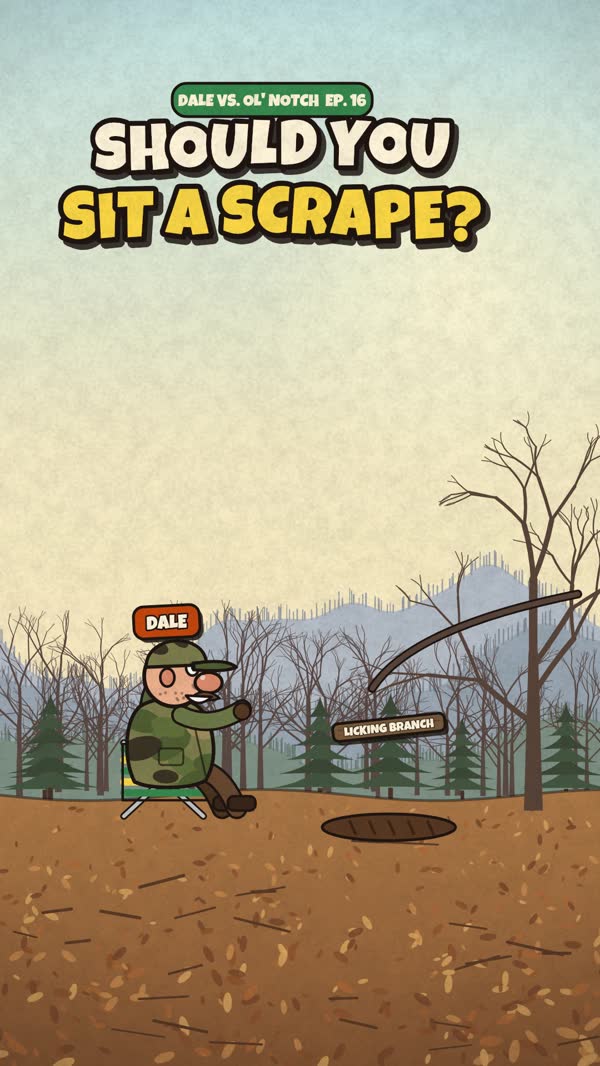
01What the research found
RECEIPT
The study
Who visits a scrape, and when
WhereAmes Research and Education Center, southwest TennesseeSample107 scrapes on camera, 3,063 scrape visits, 218 different bucksWhenSeptember 2021 to January 2022
What they did
Put trail cameras on scrapes for a full breeding season and logged every visit by age, sex and time of day.
What they found
- 67% of scrape visits came at night.
- Fawns made the highest share of their visits in daylight (46%). Bucks 4.5 and older made the lowest (16%).
- The most common thing bucks, does and fawns did at a scrape was work the licking branch overhead, not paw the dirt.
- Scraping peaked in the first half of November, just before the rut, then fell off as the rut went on.
Limits
- One site, one season.
- The herd had a high CWD rate (52% in mature deer that season). The day and night results compare age and sex groups, not sick and healthy deer.
- These are Tennessee dates. Rut timing differs by region, so don't copy the calendar.
Source. Huang, Demarais, Strickland, Houston, Banda and VerCauteren. 2024. "Chronic wasting disease effects on a breeding season behavior in white-tailed deer." Journal of Mammalogy 105(5):1175-1181. academic.oup.com →
RECEIPT
The study
Mature bucks quit scraping when breeding starts
WhereWoods around Tougaloo College, Mississippi (496 acres)Sample8 scrapes on camera, 503 scraping observationsWhen2019-2020 season
What they did
Watched scrapes through the season and compared scraping with the local breeding window (Dec 14 to Jan 14).
What they found
- Mature bucks' scraping dropped off hard at the start of the breeding window.
Limits
- Small study: 8 scrapes, one season, one site near a college campus.
- Mature bucks only.
Source. Hearst et al. 2021. "Scraping network analysis: a method to explore complex white-tailed deer mating systems." Southeastern Naturalist 20(1):192-211. par.nsf.gov →
02My read
MY READMy tactic, not a study result
A scrape is a signpost, not a stand. I use it to find the route, then hunt the cover he travels in daylight.
03Field notes
- Don't plan a whole sit around a scrape. Most visits came at night, and the oldest bucks were the least likely to show in daylight.
- Put a camera on the licking branch, not just the dirt. That's where most of the action was.
- Use scrapes to read the route, then set up in the cover along it.
- Check your own state's season dates and legal hours with your state wildlife agency.