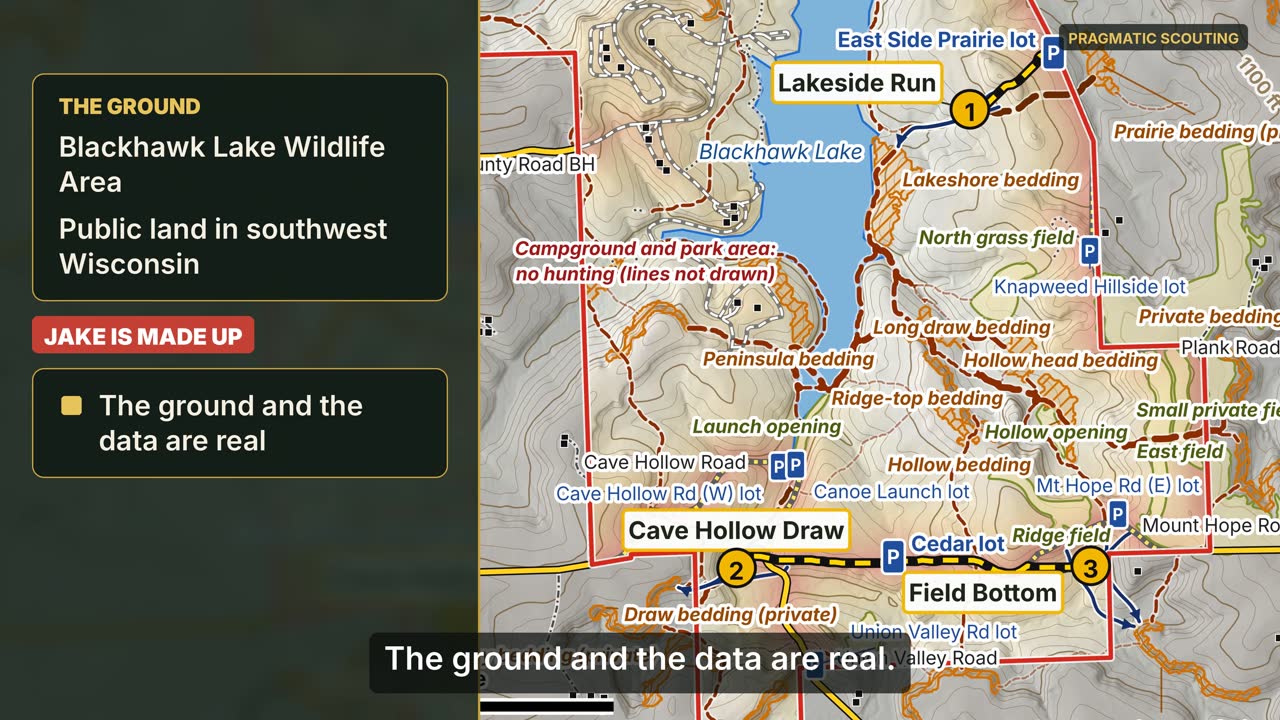
01The ground and the hunter
The ground is Blackhawk Lake Wildlife Area, real public land in southwest Wisconsin. The hunter, Jake, is made up. He's a bowhunter after a mature buck, he shoots out to 30 yards, and he carries a stand in and out every day. The plan is my sample plan, built from maps and public data. Nobody hunted it for this video.
Why your first sits matter
Set up low and high hunter density and counted how often hunters saw collared bucks on the first, second and third weekends.
- Hunters saw collared bucks the most on the first weekend, in both the low and high density setups.
- Sightings dropped each weekend after that.
- In the high density setup, bucks that were seen had been moving more just before they were seen.
- One property, two seasons.
- Rifle season, not bow season.
02Step 1: Read the map
Blackhawk Lake Wildlife Area
The Wisconsin DNR's page for the property.
- The property is 2,037 acres.
- The DNR manages 1,500 acres as a wildlife area.
- Iowa County leases 330 acres as a recreation area.
- Camping and bathrooms are only in the county-leased recreation area.
- An agency page, not a deer study.
The lidar layer
A laser scan flown from a plane that shows the ground under the trees.
- The Iowa County block was collected April 10 to 11, 2022.
- The record says it was flown in spring 2022 with no snow on the ground.
- Not a deer study. It shows the shape of the ground, not where deer are.
- The record I opened doesn't say "leaf-off."
Where hunters go on public land
Counted hunters from the air during the bear and deer rifle seasons and modeled where deer hunters were.
- An estimated 87% of deer hunters hunted within 0.5 km of a road, about a third of a mile.
- Distance from the nearest road and slope predicted where deer hunters went.
- One study, one region.
- Rifle season, counted from the air.
No study I found tested whether deer bed where a bedding model like mine says. Confirm bedding with tracks and cameras.
03Step 2: Legal and safe
Season dates, shooting hours and land rules change every year and every state. Check your state's current regulations and the property's own rules before you go. Use your state's shooting hours, not a sunrise app.
Where you can't hunt at Blackhawk
The county recreation area's own hunting page.
- The page says hunting and trapping in the campground and park area is "absolutely prohibited."
- It tells hunters to follow all Wisconsin DNR rules.
- The park's page, not a DNR rule. Rules can change.
Stand rules on DNR land
The DNR's page of rules for DNR-managed lands.
- South of State Highway 64, a stand or blind can stay up only from one hour before to one hour after shooting hours each day.
- Cutting shooting lanes and using screw-in tree stands count as damage to trees.
- An unoccupied stand needs your DNR customer ID number, or your name and address, where it can be read.
- Wisconsin only. Check the current rules each year.
Shooting near roads
The DNR's hunting regulations page on roads.
- You can't shoot an arrow from a bow or crossbow from or across a highway.
- You can't shoot one within 50 feet of the roadway's center.
- Wisconsin only. Check the current rules each year.
04Step 3: Wind and scent
How air moves on a slope
The National Weather Service glossary entries for slope winds.
- An along-slope wind system is a closed, thermally driven daily circulation. Its lower branch blows up or down the slope.
- Downslope flow is thermally driven and usually happens at night.
- A weather glossary, not a deer study. Your hill, shade and cover can change it.
No study I found tested how far a deer can smell you, or which way GPS-collared bucks travel compared to the wind.
05Step 4: Picking the stands
How long bucks avoid a hunted stand
Auburn University research by Clint McCoy, described in a SC DNR news release.
- Bucks avoided a stand's area for about 3 days after it was hunted.
- Even after 5 days, they were less likely to visit than before the stand was ever hunted.
- One property.
- A news release, not a journal paper. I couldn't find it in a journal.
- It supports spacing your sits. It doesn't test my rest rule numbers.
The sample stands (Blackhawk, made-up hunter)
| Stand | Where | Wind | Walk in |
|---|---|---|---|
| 1. Lakeside Run | South-facing sidehill east of the lake | Steady SE or S. SW is the second choice | East Side Prairie lot, about 450 yards, in from the northeast, never across the trail |
| 2. Cave Hollow Draw | Bottom of a draw | Steady W or NW | Cedar lot, about 700 yards along Mount Hope Road, then down into the draw |
| 3. Field Bottom | Wooded bottom south of Mount Hope Road | NE, E, and calm mornings | Cedar lot, about 875 yards. A closer lot's walk crosses the trail, so skip it |
| N, WSW or NNW | No stand | Scout or rest a stand |
06Step 5: The day by day plan
When southwest Wisconsin bucks move
Tracked GPS-collared bucks through the breeding season and compared movement by age.
- Movement peaked in Week 4, November 5 to 11, by the mean movement rate of all ages.
- Bucks 3 and older shifted toward night, especially in the peak rut. Yearlings were more active at dawn.
- The DNR's write-up puts the peak at about November 1 to 7.
- The study area is mostly private land.
- Peak movement is a good window, not a sure thing.
Deer and the day of the week
Compared deer behavior by day of the week against the pattern of hunting pressure.
- In daylight on Sundays, compared with Fridays, the chance a deer was active dropped 24%.
- Movement rate dropped 17% and net displacement dropped 31%.
- The daytime shift lasted until Wednesdays.
- No change by day was found at night.
- Weekends as a block (Friday to Sunday) looked about the same as weekdays. The effect only showed up day by day.
- Alabama, with a long season.
07Step 6: After the shot
How long to wait before tracking
Two NDA articles on recovering a hit deer.
- Heart or lung hit with a bow: wait 15 to 30 minutes.
- Liver: 8 to 10 hours. Guts: 10 to 12 hours.
- A second NDA article says 8 to 12 hours for a gut shot, and to wait until the next morning after a late evening gut shot.
- Advice articles, not research.
Registering your deer
The DNR's deer registration page.
- Register your deer through GameReg by 5 p.m. the day after recovery.
- Wisconsin only. Check the current rules each year.
08My read
Your first few sits on a fresh spot are your best ones. Don't spend them on a guess.
Map order: lidar and cover for likely bedding (thick cover, steep ground, away from people), then food, then travel between the two, then people. I map pressure off every lot and road. My bedding, travel and pressure layers are a model. Confirm them with tracks and cameras.
Mark every building on the map and never put a shot toward one. Wear an orange cap on every daylight walk, in or out, scouting included.
One wind table: each wind gets a Best stand, an OK stand, or no stand. On a no-stand wind, scout or rest a stand. Under 7 mph with a clear sky, I only use a stand where the downhill air carries my scent away from the deer. Plan as if a buck comes in from downwind. In my count of 10 years of NOAA hourly records from the Iowa County Airport on Jake's dates, some stand fit 122 of 152 mornings and 101 of 152 evenings. The rest, nothing fits. Plan for it.
Check the hourly forecast the night before, and trust your puffer at the truck. A forecast 6 to 9 days out will change.
Score every spot on the same rules: travel, bedding, pressure, the walk in, and wind. Three stands that cover different winds beat three great stands that all want the same one. A great tree with a bad walk in is a bad stand. If a doe gives Jake a chance, he takes it at stand 2 or 3 and saves stand 1 for a buck.
Leave times: 35 yards a minute, a little extra for the uphill, and 30 minutes to hang the stand and climb, so you're settled 20 minutes before legal light. Don't get to the tree before the stand is allowed up.
Rest rule: sit a stand up to 3 times, then rest it at least 4 days. An all-day sit counts as 2, and every climb counts. No study I found tested this.
Weekdays beat weekends for a sit. No study I found tested this. Don't burn your only stand for a wind on day after day of that wind. Scout those days at midday instead, orange cap on, out of the bedding, and save its last sits for your best days. When a long stretch ends, rest every stand before you start fresh.
Wind turns wrong on stand: climb down when no deer are in sight and go where the table says, or scout. Bump deer walking in: finish the sit, then rest that stand 4 days. A truck at your lot: go to another stand that fits, or scout.
After a bow hit to the heart or lungs, I wait 30 minutes to an hour, and only if I'm sure. If I'm not sure, I treat it as a gut hit. If a liver or gut wait ends after dark, go back the next morning. After an evening shot on DNR land, take your stand down before you track.
Keep a sit log. No study I found tested whether one helps you kill more deer. I keep one because the rest rule only works if you count, and what deer actually do on that ground beats any model, mine included.
09Field checklist
- Read the whole map before you pick a tree: ground, cover, bedding, food, travel, then people.
- Mark where hunting is closed, every road, and every building. Nothing goes near them.
- Check this year's season dates, shooting hours and property rules with your state agency.
- Put the stand where every trail passes inside your range. Jake's is 30 yards, so 15 to 25 yards out.
- Build one wind table. Every wind gets a Best stand, an OK stand, or no stand.
- At the truck, check the wind with a puffer. No stand fits? Scout or rest.
- Plan the walk in so it never crosses the trail, even if it's longer.
- Count every sit on every stand, and rest a stand once it hits its limit.
- After the shot, mark where the deer stood and where you last saw it. Sneak out and wait.
- Register the deer on time. In Wisconsin it's GameReg by 5 p.m. the day after recovery.
- Keep a sit log: date, stand, time in and out, wind and sky, every deer seen with time and direction, and anything you bumped.