01When is the rut?
SEPOCTNOVDECJANFEB
Pennsylvania, 9 in 10 does bred
New York, breeding season
Wisconsin, peak breeding
South Carolina, does bred
South Texas, peak rut
Mississippi, peak by county
When breeding happens, by study. Bars are approximate where a source says "mid-month" or "late." Red = peak; green = the whole window.
RECEIPT
The study
Pennsylvania: road-killed does
WherePennsylvania, statewideSampleMore than 6,000 doesWhen2000-2007
What they found
- About 9 in 10 were bred from mid-October to mid-December, with the peak in mid-November.
Limits
- A summary page with no author or date.
- Road-killed does only.
Source. Pennsylvania Game Commission, "When Is the Rut?"
RECEIPT
The study
New York, Wisconsin and South Carolina
WhereNY, southwest WI, SCSampleAgency summary; 188 GPS bucks; 36 GPS doesWhen2002; 2017-2020; one property
What they found
- New York: breeding from October to January, peaking in mid-November.
- Wisconsin: peak breeding about October 23 to November 12, roughly three weeks.
- South Carolina: does were bred from September 11 to November 2.
Limits
- The New York article (2002) gives no data.
- The South Carolina does were on one property.
Source. NY DEC, New York State Conservationist, Oct 2002. Hunsaker et al. 2025, Ecology and Evolution. Sullivan et al. 2017, Ecology and Evolution.
RECEIPT
The study
Does weather change it?
WherePennsylvaniaSampleAlmost 98,000 buck locationsWhen2013-2023
What they found
- When bucks moved more or less than normal, it had no relationship with temperature.
Limits
- A blog post, and the number of bucks isn't given.
Source. Diefenbach, "The Heat Is On...," Penn State Deer-Forest Study blog, Jan 6, 2025.
02Where bucks go
RECEIPT
The study
Trips outside the home range
WhereChesapeake Farms, MarylandSample32 adult bucks, GPSWhen2003-2007
20 of 3220 of 32 bucks made at least one trip
What they found
- A trip meant 6+ hours and at least half a kilometer (about a third of a mile) past the range.
- The average trip lasted 10.5 hours.
- 22 of the 37 trips fell between October 15 and November 25. Breeding was the likely driver, not hunting pressure or food.
Limits
- One farm of about 3,200 acres.
- Not enough collared does to match the trips to does.
Source. Karns et al. 2011, Southeastern Naturalist 10(1).
RECEIPT
The study
Focal areas
WhereKing Ranch, South TexasSample101 bucks, GPS, hourly
What they found
- In the rut, bucks worked 2 to 3 focal areas.
- About 60% went back to them every 24 to 28 hours.
- They used only 20 to 40% of their home range.
- The focal areas lined up with doe core areas.
- The researchers: "if you see a buck in the same area more than once during peak rut, he will probably be back."
Limits
- One ranch, where the peak rut is December 2 to 15.
- The link to does rests on 5 collared does.
Source. Foley et al., "Making Sense... of the Madness," Quality Whitetails, Oct/Nov 2015.
RECEIPT
The study
Bedding
WhereMississippiSample60 bucks, GPS
What they found
- About 31 bedding areas a season.
- All season, back to a bedding area about every 6 days. In the rut, about every day and a half.
Limits
- One region, in thick southern cover.
- "Same area" isn't the same bed.
Source. Resop et al., "You Know Where That Buck Beds, Huh?," National Deer Association, Apr 10, 2024.
RECEIPT
The study
Lockdown
WhereNorthern PennsylvaniaSample15 collared, 3 with full records
What they found
- A doe is in estrus about 24 to 48 hours.
- No multi-day "honeymoon" was seen.
Limits
- Only 3 bucks.
Source. Thomas, "Is the 'Lockdown Phase' a Myth?," National Deer Association, Oct 30, 2013, on Andy Olson's work.
03What the does do
RECEIPT
The study
Doe trips around breeding
WhereSouth Carolina; Maryland and DelawareSample36 GPS does; 10 GPS doesWhenSullivan 2017; Kolodzinski 2008
What they found
- South Carolina: 21 of 36 does were bred and 11 of those made a trip. The chance a doe was off her range peaked the day before breeding, at about 6% on any one day.
- Maryland and Delaware: 9 of 10 does made a trip, about a day on average. Two crossed an arm of the bay 100 to 150 meters wide.
Limits
- South Carolina was one property with feeders and food plots, and couldn't tell if the trip came before or after she met a buck.
- Maryland and Delaware was 10 does.
Source. Sullivan et al. 2017, Ecology and Evolution. Kolodzinski 2008, M.S. thesis, University of Georgia.
04Daylight or dark?
RECEIPT
The study
The studies don't agree
WhereMS, PA, WISample40+ bucks; Penn State locations; 188 bucks
What they found
- Mississippi: bucks 2 and older moved about a third of the time in daylight in October and November, over 40% in the rut.
- Pennsylvania: at peak breeding, bucks moved about twice as far at night, with longer nights part of the reason.
- Wisconsin: bucks 3 and older shifted toward night; yearlings toward dawn.
- No study I found explains why they disagree.
Limits
- The Mississippi figure is from a news story with no site or years given, and their peak breeding runs late November to mid-February, so their October and November is before the rut.
Source. MSU Extension, Nov 19, 2020. MSU Deer Lab, "Ecology of the Rut." Diefenbach 2025. Hunsaker et al. 2025.
05How the air moves
RECEIPT
The study
Slope winds
WhereFire weather guidesSampleNot deer studies
What they found
- Air flows up a slope in the day and down at night, like water. Cool air collects low.
- It starts up within minutes of the sun hitting the slope: about 3 to 8 mph up, 2 to 5 mph down.
- It goes back down once the slope is in afternoon shade. A strong general wind wins.
Limits
- These are fire weather guides, not deer studies. Your hill, shade and cover can change it.
Source. Encyclopedia of Southern Fire Science. National Wildfire Coordinating Group wind guide. NWS Nashville fire weather training.
06My read
MY READMy tactic, not a study result
In the rut, a lot of bucks run a loop: a few spots, over and over, about once a day, tied to the does.
Map order: food, doe bedding, the connections between doe areas, the downwind side of the bedding, the way in and out, then the tree. Every stand gets a wind, a way in and out, and a time to stay out.
When the woods go dead in mid-November, a lot of bucks are probably with a doe for a day or two. Sit closer to the does. Don't stay home. For daylight, sit long and sit close to the does.
No study I found tested funnels and pinch points, or whether bucks scent-check the downwind edge of bedding.
The example stands (made-up ground)
| Stand | Wind | When | In and out | Stay out |
|---|---|---|---|---|
| 1. East edge of the timber cut | W or NW | Evenings. All day mid-rut, only on a steady W or NW | SE parking, up the creek, never across the cut | Any other wind, or milkweed drifting toward the cut |
| 2. The saddle | Steady S | Late morning to mid-afternoon | SW parking, up the west line, north side of the ridge | Calm or light mornings, any wind but S, once the sun leaves the slope |
| 3. Creek crossing | N | Mornings | SE parking, straight up the creek | Any wind but N |
| NE, E, SE or SW | No stand | Hunt somewhere else |
Rest rule: bumped deer going in or out, or the wind went wrong? Rest that stand and hunt another. No set number of days.
07Field checklist
- At the truck, check the wind. No stand built for it? Hunt somewhere else.
- Know legal light. In PA and NY it's a half hour before sunrise to a half hour after sunset. Check your own state.
- Walk the route you planned, never through the bedding.
- Check milkweed every 20 to 30 minutes. Drifting toward the does? You're done there for the day.
- Watch for the flip: downhill at first light, uphill once the sun's on your slope, downhill again in the afternoon shade.
- Same buck, same spot, twice? Stay.
- Leave the way you came in, away from the does.
08Common mistakes
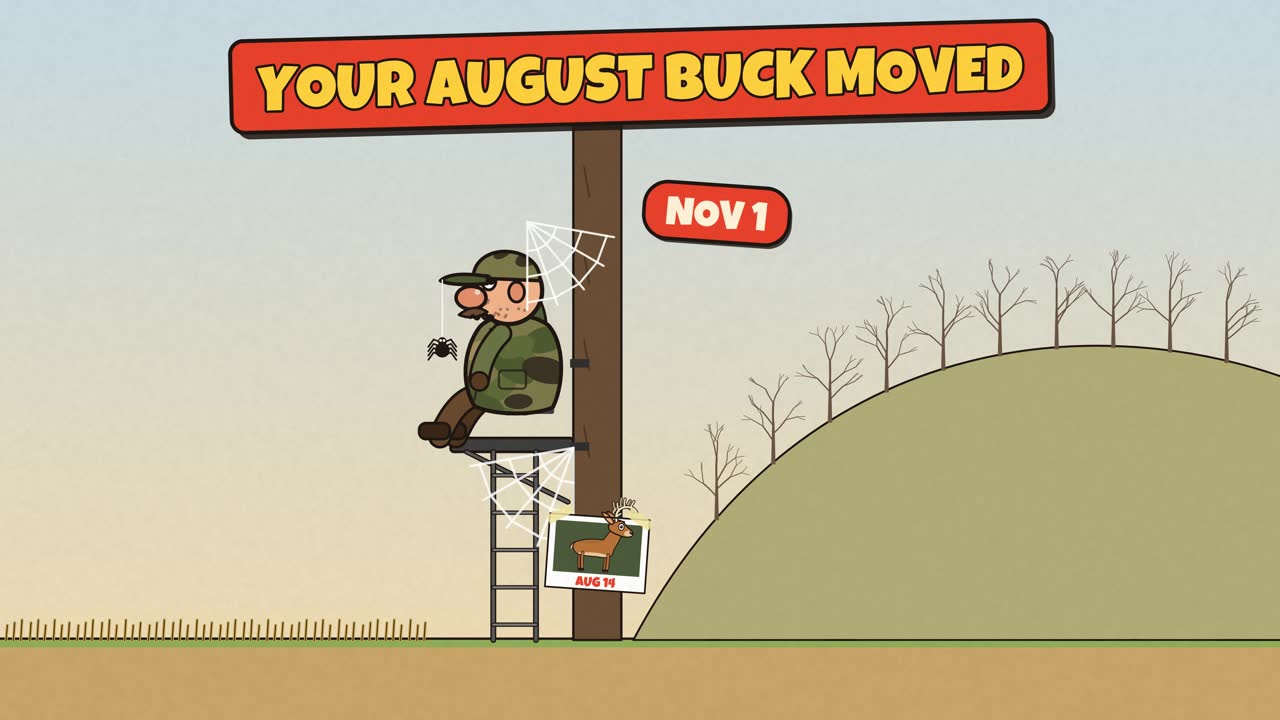
MISTAKESitting the August stand in November.
INSTEADMove to the does and the connections between them.
MISTAKEPlanning around the moon or a cold front.
INSTEADPut your days where your state's breeding data puts the peak.
MISTAKEGoing home when the woods go dead.
INSTEADKeep hunting the doe bedding.
MISTAKEWalking through the bedding to your stand.
INSTEADPlan the way in and out first, even if it's the long way.
MISTAKETrusting the forecast at first light.
INSTEADIt's still night air sliding downhill till the sun's on the slope. Check your milkweed.
MISTAKEChasing does that vanish for a day.
INSTEADStay near the bedding. That's where it all comes back to.
09Summary
- The rut is a window, not a date. In PA and NY, it's mid-November.
- A lot of bucks work a few spots over and over, tied to the does. Find the loop.
- Does leave sometimes, right around breeding, but it's short. Keep hunting the bedding.
- Daylight? The studies don't agree. Sit long, and sit close to the does.
- Map order: food, doe bedding, connections, the downwind side, the way in and out, then the tree.
- Every stand gets a wind, a way in and out, and a time to stay out.